The Complete Guide to Peonies for Florists
An interview with Chief Peony Officer Marty Star
Peonies are among the most beloved flowers in the world of floristry. Their dramatic bloom, rich colours and seasonal character make them one of the most iconic flowers of spring. But what makes peonies so special for florists? We spoke with Marty Star, founder of My Peony Society, a collective of specialized peony growers, about why this flower continues to captivate florists around the world.
Why are peonies so loved by florists?
Marty believes the answer begins with the florists themselves. “Good florists are becoming increasingly rare,” he says. “The best florists are the ones who truly understand flowers and are able to translate that passion to their customers. What they almost always share is a deep love for seasonal flowers.”
Seasonal flowers, he explains, offer something that year-round flowers rarely provide: anticipation and transformation. “What seasonal flowers do, more than flowers like gerberas or chrysanthemums, is that they create drama in the vase. They often arrive as a modest little bud, and then they explode into bloom with incredible intensity.” Watching that transformation unfold is part of the fascination. The flower slowly opens, the colours deepen, and eventually the bloom fades again. For Marty, this life cycle reflects something deeper. “Flowers symbolise the celebration of life and the contrast with death. Carpe Diem. Of all seasonal flowers, the peony is perhaps the most dramatic of them all.”
Another reason peonies are so admired is their presence. While many flowers play a supporting role in a bouquet, peonies can easily stand on their own. “Where other flowers are often highlighted within a bouquet, a peony can perform as a standalone spectacle. It is truly the ultimate flower.”
What makes a peony high quality for floristry?
Peonies are naturally strong flowers, but according to Marty their quality depends almost entirely on one moment: the harvest. “To fulfil the promise of bloom, it is essential that peonies are harvested at the right stage of maturity.”
Within the peony industry, growers often work with a five-stage maturity system. At the earliest stage the bud is still tight and immature. At the final stage the flower is fully open. The perfect moment for harvest lies in between.
“At My Peony Society our growers harvest peonies at stage two,” Marty explains. “That is the perfect moment for transport and for florists to work with the flower.” By the time the flowers reach the florist, professionals sometimes use additional classifications such as stage 22 or 23 to describe subtle differences in maturity.
Even when the buds are still closed, peonies already attract attention. “The buds are already large and impressive while still closed. That creates curiosity. People see this enormous bud and wonder what will emerge from it.” And when the flower finally opens, the transformation can be spectacular.
What makes peonies so unique compared to other flowers?
One of the most striking characteristics of peonies is the scale of their bloom. “Some varieties have a bud of only five centimeters when closed,” Marty explains. “But when they open, they explode into flowers of fifteen centimeters or more.”
Another fascinating trait is the way some varieties change colour as they bloom. This gradual transformation is known as ‘colour fade’. “These colour transitions are incredibly special,” Marty says. “Some peonies change dramatically during opening.”
Beyond their visual beauty, peonies also offer practical advantages for florists. Their stems are strong, their flower heads are large, and many varieties are fragrant. “They are also very strong flowers that can last a long time in the vase,” Marty explains. “If properly cooled, florists can even store them for extended periods and work with them when needed.”
Which peony varieties are most popular among florists?
When it comes to favorite varieties, preferences differ from florist to florist. Still, certain classics remain widely known. “For example, Duchesse de Nemours is still widely seen as the traditional white peony,” Marty says. “In reality, however, there are now many varieties that outperform it in quality.”
Among the florists working with My Peony Society, two varieties are particularly admired: Command Performance and Coral Sunset. “These two varieties already have enormous buds, but they are also true colour transformers,” Marty explains. “They change colour as they open, which creates an incredible visual effect.”
Peonies themselves appear in different flower forms. Some open into perfectly round, bomb-shaped blooms, while others unfold more gradually with a softer cup shape similar to roses. There are also single and semi-double varieties, where the center of the flower remains visible.
Another category are the Itoh peonies, which originate from shrub-like plants rather than herbaceous perennials. These varieties often bloom early, although they generally have a shorter vase life and are therefore less commonly used as cut flowers.
Which peony varieties stand out by colour?
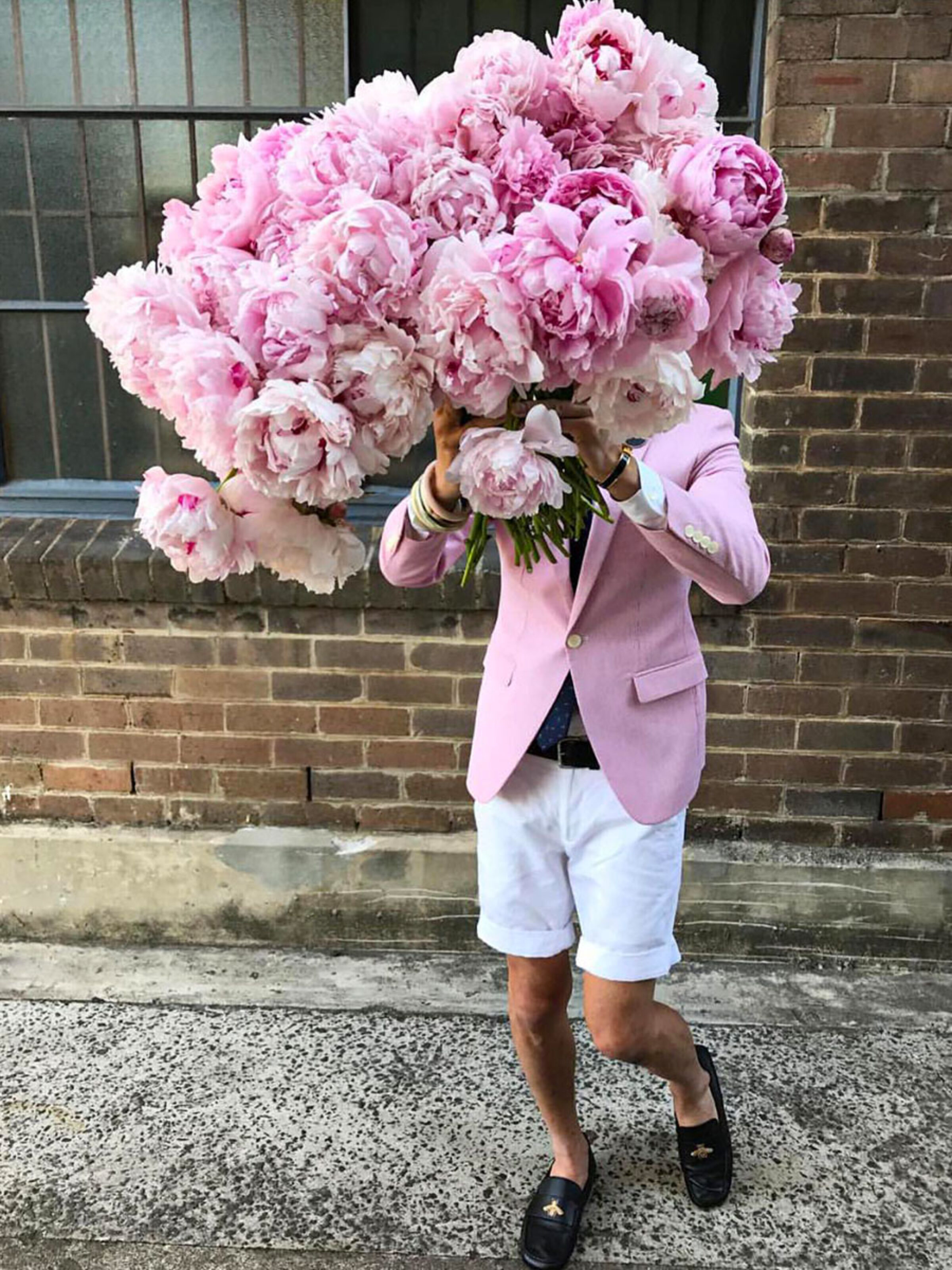
When discussing famous peonies, colour often plays a defining role. Pink peonies remain the most iconic. According to Marty, one variety stands above all others. “When people think of peonies, they almost always imagine Sarah Bernhardt.”
Other pink varieties such as Reine Hortense and Pillow Talk have gained popularity as well, often performing better in warmer climates or offering improved bud presentation. Varieties like Dinner Plate and Angel Cheeks are admired for their enormous blooms and distinctive flower shapes.
In deeper tones, cerise varieties such as Avis Varner, Paul M. Wild, and Best Man bring strong colour intensity to arrangements. Meanwhile, salmon and coral peonies have become increasingly popular in modern floral design. Marty highlights Etched Salmon in particular. “It is a peach-salmon double variety with hundreds of petals. One of the most elegant peonies you can find.” Varieties like Pastelegance and Kingsday offer similar warmth with apricot and coral tones.
Among white peonies, several varieties are known for their impressive size and purity. Madame Claude Tain, Dr. F.G. Brethour, and Bowl of Cream are widely admired, while Colonel Owen Cousins is often described as producing one of the largest peony blooms in existence.
When asked to name the most beautiful peonies in the world, Marty smiles. “For me, the top three would be Colonel Owen Cousins, Command Performance, and Etched Salmon. But beauty in peonies is always a matter of taste.”
What is the biggest mistake florists make with peonies?
Despite their strength, peonies require careful handling. “The biggest mistake is cutting the stems with scissors instead of slicing them with a knife,” Marty says. Peony stems contain delicate vascular channels that transport water and nutrients. When stems are crushed or squeezed by scissors, these channels can become blocked. “That prevents proper water uptake, which reduces vase life.” Using a sharp knife keeps the stem open and allows the flower to absorb water more effectively.
How can you recognize a peony that will open perfectly?
For florists, recognizing a good peony bud is an important skill. “A high-quality bud will already show rich colour rather than green,” Marty explains. “The outer petals may feel slightly loose, and the bud should feel soft rather than rock hard.” Fresh foliage is another important indicator. Together, these signs suggest that the flower has reached the right maturity and will open beautifully.
Why are peonies so popular in wedding bouquets?
Peonies are strongly associated with romance and celebration, which makes them a natural choice for weddings. “Their large blooms create instant impact,” Marty says. “And because they open gradually, they add movement and transformation throughout the event.” For many couples, peonies capture the essence of elegance and abundance.
What makes My Peony Society different from other suppliers?
My Peony Society works as a collective of specialized growers, a model that allows the organization to offer both diversity and consistency. “Our growers combine their expertise and harvest periods,” Marty explains. “That allows us to offer a longer season and extremely consistent quality.” The collective also provides access to one of the largest assortments of peony varieties available. “We combine depth of assortment with the ability to deliver at scale,” Marty says. “That is what makes us unique in the global peony market.”